
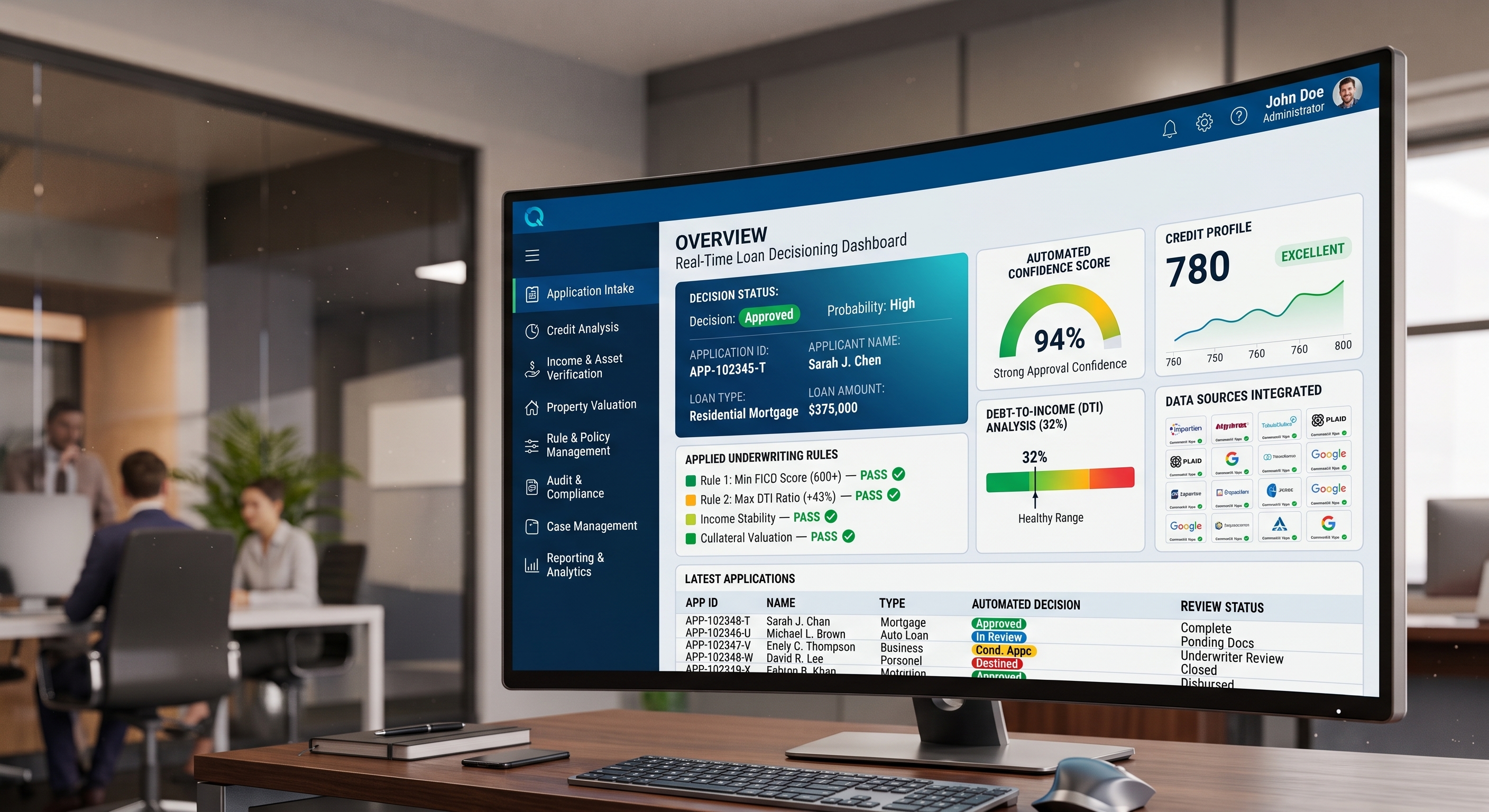
How Real-Time Loan Decisioning Is Changing Modern Lending
A borrower can complete an application in minutes. For the lender, however, submission is only the beginning. Information may still need verification. Risk signals have to be reviewed. Credit policy must be applied. When those steps depend on disconnected data sources, separate systems, or manual handoffs, an otherwise workable application can end up waiting for a decision. That delay has consequences. Borrower intent can fade as underwriting queues grow, and teams spend more time moving information than evaluating risk.
A fast application means little if the decision behind it still moves at yesterday's pace. Real-time loan decisioning closes that gap by helping lenders evaluate incoming applications and decide the next step while the borrower is still active in the lending process.
What Is Real-Time Loan Decisioning?
Real-time loan decisioning is the process of evaluating borrower information against lender-defined rules, risk criteria, and available data as an application moves through the lending workflow. Instead of waiting for separate reviews or manual handoffs, lenders can evaluate relevant information and determine the appropriate path while the application is active.
“Real-time” does not mean every applicant receives an instant approval. The outcome still depends on the lender’s credit policy, available data, and risk appetite. An application may result in an approval, decline, conditional outcome, request for additional information, or referral to an underwriter for manual review. The value lies in reaching or routing that outcome without unnecessary delay.
Real-Time Loan Decisioning vs. Automated Loan Underwriting
Automated loan underwriting and real-time loan decisioning are closely related, but they describe different parts of the process. Automated underwriting uses predefined rules, borrower data, and risk criteria to evaluate creditworthiness with less manual intervention.
Real-time loan decisioning focuses on how quickly those rules and signals can produce an actionable outcome. In practice, that outcome may be a lending decision or a clear route to the next required review.
Why Traditional Loan Decisioning Is No Longer Enough
Traditional loan decisioning still has a place in lending. Complex applications and exceptions often need human judgment. Problems arise when routine applications face the same manual steps.
Borrower Intent Has a Short Window
Applicants can approach several lenders without much effort. When an otherwise workable application sits in a queue, the lender risks losing a borrower who is still looking elsewhere. Decision latency can quickly become conversion friction.
Manual Review Does Not Scale Linearly
Higher application volume creates more work when routine decisions depend on individual review. Queues grow, turnaround times stretch, and experienced underwriters spend valuable hours on cases that established rules could resolve. The expensive part of slow decisioning is not always the wait. Sometimes it is where skilled people spend their time.
Fragmented Data Slows the Decision
Credit, bank, identity, and fraud information may come from different providers. If teams have to retrieve, reconcile, or move that information manually, every additional step creates another opportunity for delay.
Inconsistent Decisions Create Another Risk
Speed alone does not determine decision quality. Heavy dependence on individual handling can also make established policy harder to apply consistently. Similar applications may follow different paths when rules, data, and review processes are not coordinated.
How Real-Time Loan Decisioning Works
Real-time loan decisioning starts when an application enters the lender’s workflow. From there, the system gathers the information needed to evaluate the applicant, applies established lending policy, and determines what should happen next.
1. Application Data Enters the Workflow
Borrower information provides the starting point. Required fields can be checked for completeness, while basic eligibility criteria help determine whether the application should proceed. Missing information may need to be resolved before further evaluation takes place.
2. Relevant Data Is Retrieved
Depending on the lender’s policy, additional information may come from credit bureaus, bank data, identity services, fraud providers, or other integrated sources. Each data call should serve a purpose. More data is not automatically better. Useful data is information that changes or strengthens the decision.
3. Lending Rules Are Applied
Next, the modern loan decision engine evaluates the available information against lender-defined criteria. Eligibility requirements, scorecards, risk thresholds, product rules, and other underwriting conditions can all influence the outcome. The technology executes the policy. The lender still determines what constitutes acceptable risk.
4. An Outcome Is Produced or Routed
Straightforward applications may receive an automated approval or decline when the available information supports one. Other cases can be routed for manual review, additional verification, or further documentation.
Real-time decisioning, therefore, does not always mean an instant yes or no. Sometimes its value lies in identifying an exception immediately and sending it to the right place.
5. The Decision Is Recorded
The data considered, rules applied, and resulting outcome should leave a clear record. That history gives lenders greater visibility into how decisions were reached and supports reporting, internal review, and compliance processes.
6. Portfolio Outcomes Feed Future Policy
A decision made at origination is ultimately tested after funding. Repayment behavior, delinquency, first-payment default, and eventual losses reveal how well the original risk strategy performed.
Those outcomes give credit teams evidence for reviewing thresholds, rules, and scorecards. Approval alone does not prove that a decision was good. Portfolio performance does.
Key Benefits of Real-Time Loan Decisioning
Real-time decisioning changes more than how quickly an answer reaches the borrower. Its larger value appears in how lenders apply policy, allocate underwriting resources, and manage growing application volume.
1. Shorter Time to Decision
Borrower interest does not remain static after an application is submitted. Unnecessary queues give applicants more time to continue looking elsewhere. Real-time decisioning keeps straightforward applications moving while reducing the operational lag between submission, evaluation, and the next lending action.
2. Greater Policy Consistency
Configured rules allow comparable applications to be evaluated against the same criteria. That reduces unnecessary variation between routine decisions and makes credit policy easier to enforce across higher volumes. Consistency, however, is only as good as the rules behind it. Poorly designed criteria simply produce poor outcomes more consistently.
3. Better Use of Underwriting Resources
Not every application requires an experienced underwriter’s attention. Routine cases can move through automated decision paths, leaving specialists to investigate exceptions, conflicting information, and applicants that require judgment. Human expertise becomes more valuable when it is concentrated on decisions where context can actually change the outcome.
4. Faster Use of Available Risk Signals
Integrated data can be included in the evaluation while the application remains active. Bank, identity, fraud, credit, and other relevant signals no longer have to become separate manual checkpoints. Lenders can act on useful information earlier, provided each signal has a defined role in the decision strategy.
5. More Control as Volume Grows
Higher application volume should not automatically create longer underwriting queues. Real-time decisioning lets established rules handle suitable cases while preserving manual paths for exceptions. Automation earns its keep when volume rises without forcing credit policy to loosen or underwriting queues to lengthen.
How to Choose a Real-Time Loan Decisioning Platform
A fast loan decision engine can still be a poor decisioning system. Lenders should evaluate what sits behind the response time and how much control credit teams retain once the platform is live.
Configurability
Credit policy changes. Teams should be able to adjust rules, thresholds, scorecards, and decision paths without turning every policy update into a lengthy technical project.
Data Connectivity
Check whether the platform connects with the data providers your operation actually relies on. A long integration list matters less than access to the right signals at the right stage.
Exception Handling
Ask what happens when an application cannot follow the standard automated path. Strong decisioning should identify exceptions and route them for appropriate review rather than forcing every case toward an automated outcome.
Decision Transparency
Credit teams need to understand which data and rules contributed to an outcome. A loan decision without a clear history becomes difficult to review, explain, or improve. That said, not only does the software make decisions, but it also keeps them transparent throughout the lending lifecycle.
Testing and Control
New rules should not enter production blindly. Look for ways to evaluate changes before exposing the broader portfolio to them.
Workflow Integration and Reporting
Consider where approvals, declines, manual reviews, funding actions, and adverse-action processes go next. Reporting should also help teams compare decision activity with later portfolio performance. Do not ask a vendor only how quickly the platform can approve a clean application. Give it an exception and watch what happens.
How Tekambi Helps Lenders Make Smarter, Faster Decisions
Tekambi connects borrower information, lending policies, and decision workflows so that applications can move in line with the lender’s risk strategy.
Apply Lending Policy Through Origin8
At the center of that process is Origin8, Tekambi’s real-time loan decision engine. Credit teams can configure rules, scorecards, filters, approval logic, and risk models without depending on engineering for every policy change. The platform can also retrieve information from integrated data providers and route applications according to configured decision flows.
Add Relevant Risk Intelligence
A decision is only as useful as the information behind it. Valid8 can evaluate bank account, identity, and behavioral intelligence before loan underwriting, giving lenders additional signals to consider before capital is committed.
Handle Different Outcomes
Not every application should follow the same path. Depending on lender-defined criteria, an applicant may move toward approval, be declined, require further verification, or be subject to manual review. When adverse-action requirements apply, NOAAQ can automate notice generation, delivery, and tracking while maintaining a timestamped record.
Tekambi connects the information, lending rules, and decision paths that determine what happens next to an application.







 <
<